


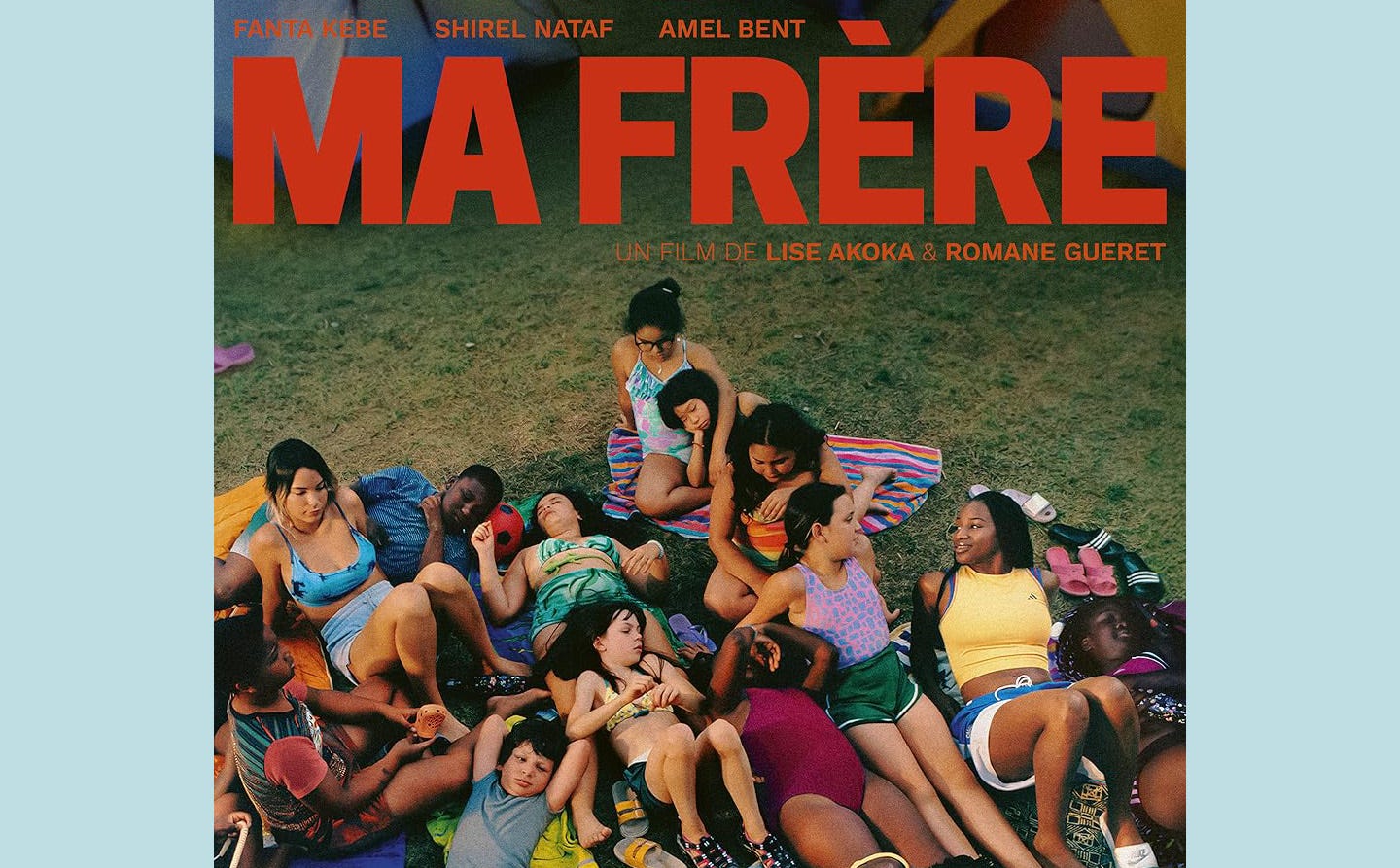
Ma Frère[1] takes place almost entirely on a summer camp for children. They are on a school trip, led by some of their teachers and a few helpers. The children are the equivalent of the final year of Junior school in the UK, aged about 10-11. They are going to the countryside from an inner-city, poorer suburb. Both children and staff find themselves away from home and work, more in a situation of play and activities, some educational, some just for fun. The children splash and swim in the river, build things with pebbles, run around, draw and sing. They go on visits to a museum and listen to an old woman who lost family in the Holocaust. There is a whole coachload of young actors as well as about half a dozen adults. To guide and utilise such a cast of young people must have been a challenge; and they perform their simple roles admirably.

The film by Lisa Akoka and Romane Gueret runs for nearly two hours, all in French with no subtitles (French or English). It has no real narrative as such, simply following the day-to-day life in the camp. There are constant brief interchanges between children, and occasional chill-out times at the end of the day for the staff. There are some arguments and mockery such as gathering round to push a boy and girl to kiss, chanting “Bisou! Bisou!” It should have been boring to someone like me with limited French, and I struggled a little during the screening. However, the richness of its simplicity haunted me the day after. It was a work of gentle genius. There are a few slight individual narratives among all the romping around. One of the staff finds that her lover deserts her at home and she faces up to her own illusions with life. One young girl is frightened and won’t speak until a long way into the film. She is looked after by a friend who always accompanies her. The female teacher kneels down on the coach before they depart and offers the timid girl a sweet, being patient as she does not reply, and giving a look of compassion. Slowly, the girl softens and responds to the teacher, so much so at the end, and talking freely, that her friend feels isolated and sad. The teacher sits down for breakfast after her breakup and several children come over and hug her at which she bursts into tears. Another adult touches her briefly and offers to pour a coffee. The scene sits motionless for a couple of minutes after that with the children comforting her without words.
Teachers can feel contained and necessarily distant sometimes because of the discipline of dealing with groups of youths. Away from work, they began to relax a little and even become teasing and playful with the children. They sneak out of their tents one night to spy on a few of their charges who they know have purloined some snacks from the supplies and are hiding in the bushes passing things around. The staff are amused, and not angry. In another scene, two boys hesitate to eat a blancmange dessert. The teacher in between them distracts one and then the other. She bends low and sucks the dessert up, deftly and speedily, so that the child does not know where it has gone. The other children laugh. They enjoy each other’s company. The teachers relax and be “human” rather than wearing the masks of monitors.
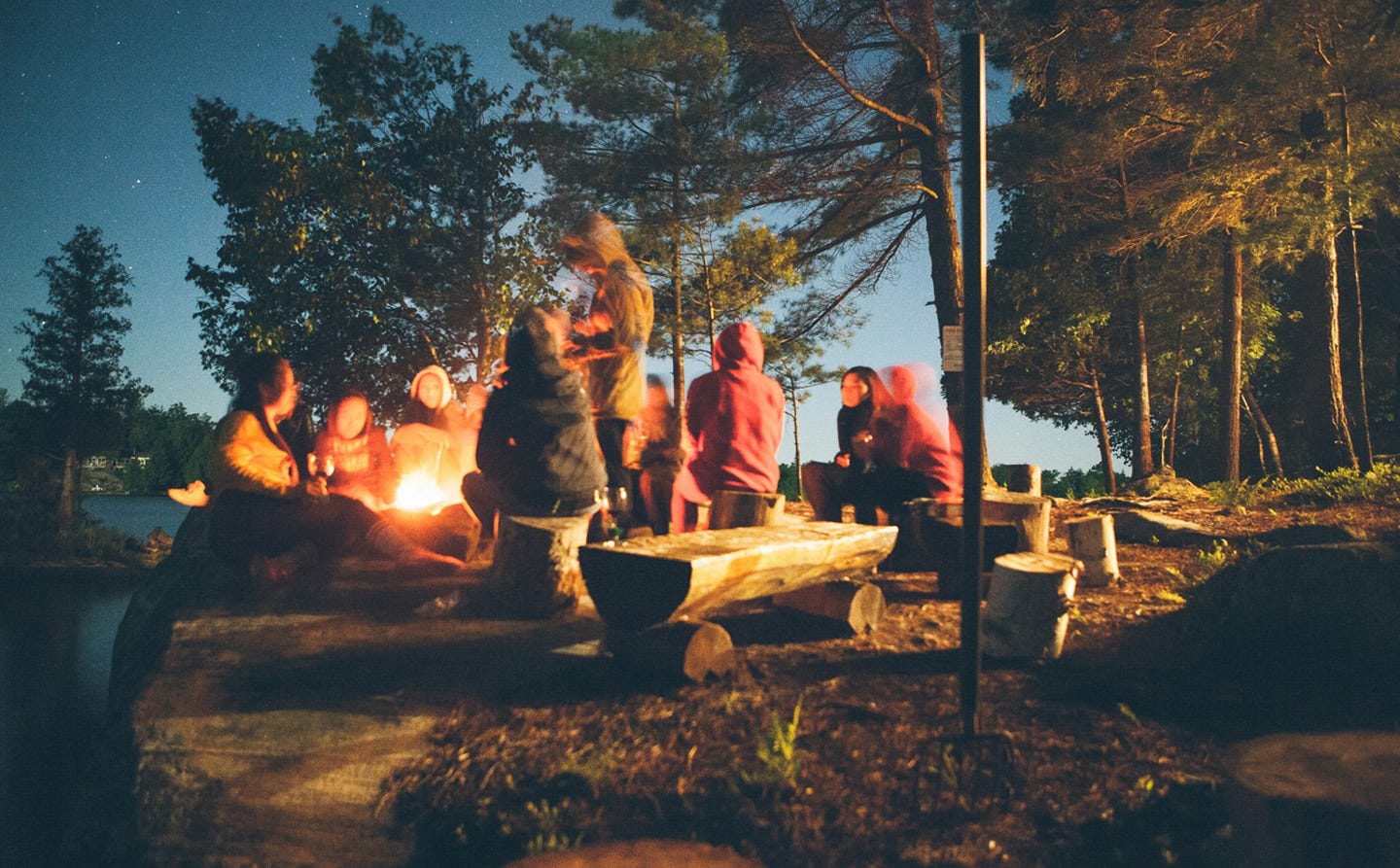
I felt frustrated at first that I did not follow much of the short exchanges of quickly paced and rather random dialogue. Upon reflection, the looks, facial expressions, body language and actions spoke much more than words, rather like when the children hugged the teacher. Its slowness and bare script allowed this to happen so naturally, and the viewer was Immersed in their lives, watching but feeling. To produce a film with so little content and narrative is no mean feat.
I was left with the value of the body and our interactions. A look does not always need words. How often do we overuse words in our lives, in our worship, our prayers or preaching? How could some biblical scenes be enacted or filmed silently? (I can think of a powerful example from Pasolini’s The Gospel According to Saint Matthew where a lengthy shot shows a dejected Joseph walking away, his back to the camera, from Mary’s family. Then he spots children playing. That turns his heart. Not a word is spoken for several minutes.) What would be said that we would sometimes miss? That is a challenge for all of us.
Kevin O’Donnell is an author, a priest of the diocese of Arundel and Brighton, and an auxiliary chaplain at the basilica of Notre Dame de Pontmain in France.
[1] I should note that the “ma frère,” not the correct “mon frère,” was a term of friendly endearment between some of the girls. Was this a playful bit of camaraderie, a touch of political correctness, or an assertion of female identity? Perhaps all of these.